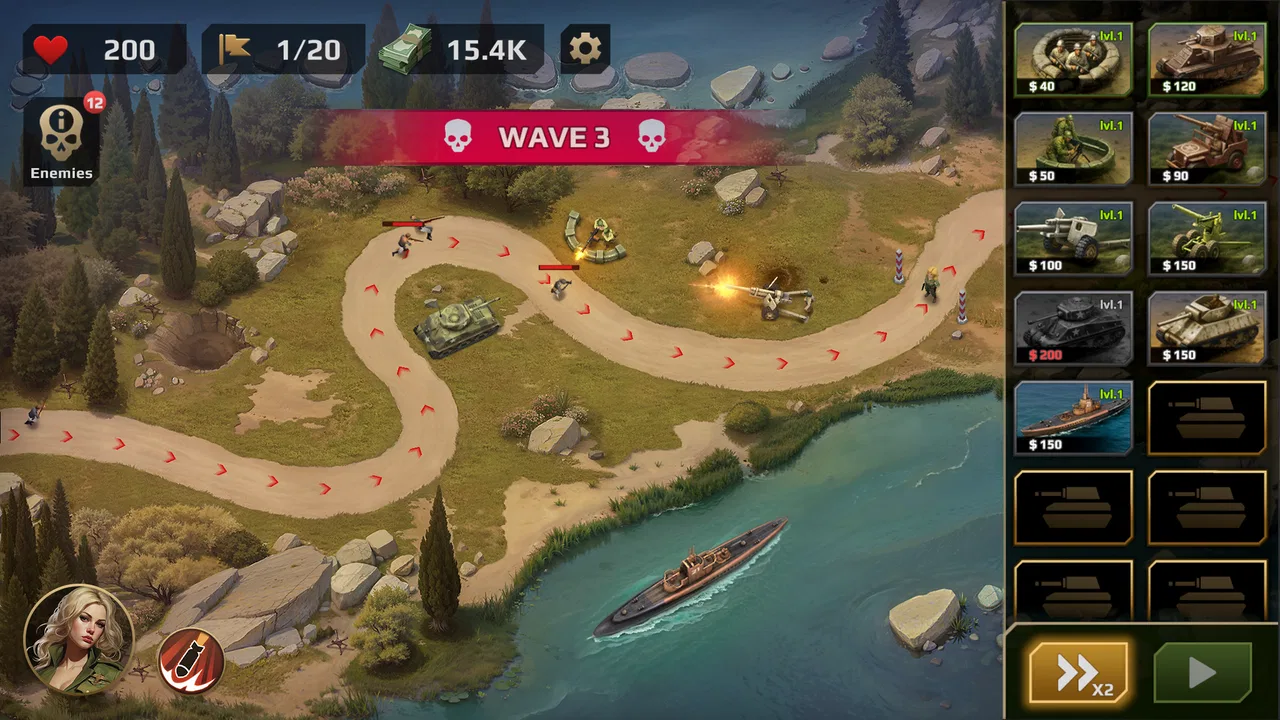
WWII Defense: RTS Army TD game
- 4.5
- Rating
- 1.00M
- Installs
- Free
- Price

 Analysis by App-foxy
I went into WWII Defense: RTS Army TD expecting a familiar tower-defense game with a wartime skin, but its appeal is more specific than that. It asks me to think about two jobs at once: placing defensive structures and directing troops during a World War II-inspired battle. That combination gives it a more tactical feel than a purely passive tower-defense game, while keeping the basic idea easy to understand.
This is a free strategy game from Azur Interactive Games Limited, aimed at Teen players. It has passed the one-million-install mark and holds a 4.5 average from roughly ninety-four thousand ratings, which tells me it has found a sizeable audience without making it automatically right for everyone. I would recommend trying it if you enjoy short tactical decisions, battlefield pressure and the satisfaction of improving a defense after a failed attempt. I would be more cautious if you want a deep long-form strategy game, a historically detailed war simulation or a completely purchase-free experience.
What I looked for before recommending it
My first decision criterion was whether the two-part design actually matters. Many tower-defense games add a second mechanic that feels decorative, but here the promise of commanding troops changes how I approach a level. I am not only asking where a defensive position should go; I am also considering when active forces should be used and how much attention the front line needs. That creates a useful layer of timing, especially when a strong defense alone is not enough to solve the situation.
You May Also Like

 Blood Strike: 2.5 Anniversary
Blood Strike’s Loadouts Turn Every Drop Into a Tactical Gamble
A close look at Blood Strike’s custom loadouts: how fast access to signature weapons reshapes its battle royale rhythm, rewards preparation, and narrows the gap between fights.

 Pandora - Music & Podcasts
Pandora’s Music Is Easy to Start, but Harder to Recover
Pandora’s strength is its low-effort path from a seed to a station. Its weak spot is how much confidence it asks you to place in connection, setup, and quiet recovery.

 8 Ball Pool
 Is Built on Rivalries, Rematches, and Routine
A close look at the rivalries, rematches, shared routines, and unanswered safety questions that turn a quick pool match into a persistent mobile community.

 Samsung Music
’s Quiet Strength Is Playing What You Already Own
Its reach comes less from spectacle than from dependable access to a personal library. That simplicity is both the app’s strongest retention engine and its ceiling.

 AccuWeather: Weather Radar
AccuWeather Review: A Quick, Clear Forecast for Everyday Decisions
For everyday plans, the best forecast is the one you can understand quickly. AccuWeather makes rain timing, radar, and local conditions easy to act on, with a few trade-offs.

 Hill Climb Racing
Why Hill Climb Racing Still Turns Crashes Into One More Run
A tiny car, a bumpy hill and one more upgrade: Hill Climb Racing keeps resurfacing because its simple chaos makes every near-miss feel personal.
More From Our News Desk



The second criterion was readability. A strategy game can become frustrating when the screen is crowded with units, effects and targets that are difficult to distinguish. In this game, I pay attention to whether I can understand the reason for a defeat. If I lose because I placed defenses badly, mistimed a troop action or spent resources too early, the next attempt feels worthwhile. If the result seems random, repetition becomes tiring very quickly.
I also considered how well it suits a phone rather than a desktop. A mobile strategy game needs decisions that can be made with touch controls and in manageable sessions. The trench-war setting supports that focused style: I can look at a battlefield, identify the pressure point and make a small number of meaningful choices instead of trying to manage an enormous empire.
Finally, I looked at the practical side. The game is free to download, but it includes optional purchases ranging from $0.99 to $124.99 per item. That does not by itself make the game unsuitable, but it means I would approach progression carefully. Anyone who dislikes seeing expensive purchase options in a free game should decide on a personal spending limit before playing, rather than making that decision during a difficult level.
How the battlefield changes my decisions
The most useful way to play is to treat every placement as part of a plan rather than filling every available position immediately. My first instinct in defense games is often to spend resources as soon as I can, but that can leave the important approach underprepared when the next pressure arrives. I get better results when I watch the route, identify where enemies will be most exposed and reserve enough flexibility to react.
That is one of the less obvious strengths of the game: it rewards restraint. A defensive position is not valuable simply because it is available. Its value depends on how long targets remain in range, whether another position can cover the same area and whether my troop deployment will create a temporary advantage somewhere else. This makes the battlefield feel more like a problem to solve than a row of empty slots to fill.
I also found it helpful to separate “survival” decisions from “improvement” decisions. During an active attack, I focus on stopping the immediate threat. Between attacks, I think about whether my setup is inefficient and whether I am relying too heavily on one location. Mixing those two kinds of decisions can lead to rushed upgrades or poorly timed deployments.
For a realistic everyday scenario, imagine playing during a short break and reaching a level that defeats you twice. Instead of continuing to tap through the same pattern, I would use the next attempt as an experiment: keep the opening arrangement simple, save resources for the first serious push and watch which lane or approach causes the defense to collapse. That turns a few minutes of play into a clear test, rather than an endless cycle of repeating the same mistake.
Why the World War II setting works
The setting gives the game a stronger identity than a fantasy tower-defense clone. Trenches, military units and battlefield objectives create a sense of urgency that fits the defensive structure. I find myself thinking in terms of holding ground and buying time, which matches the strategy more naturally than a purely decorative theme would.
At the same time, I would not choose this title as a substitute for a serious historical simulation. Its purpose is tactical entertainment, not a detailed lesson in military history. The World War II framing supplies atmosphere and context, while the actual experience remains focused on accessible mobile strategy. That distinction matters for players who want authenticity, realistic logistics or a campaign built around historical research.
The Teen content rating is also worth considering for families. It is not a game I would describe as a gentle all-ages puzzle. The military subject and combat presentation make it more appropriate for older players, even though the controls and basic objective are easy to grasp. Parents should look at the game themselves before deciding whether its presentation suits a particular younger player.
Where this game is stronger than usual alternatives
Compared with a conventional tower-defense game, this one has a better argument for players who want to feel involved in the battle. A standard defense title may be ideal when I want to build a layout and watch it operate, but this game is more appealing when I want to make decisions during the action. The troop-command element gives me another way to respond when a fixed defensive arrangement starts to fail.
It also fits players who like tactical pressure without committing to a large strategy campaign. I do not need to manage a broad economy, negotiate with other factions or learn a complicated collection of systems before understanding the main challenge. The focus stays close to the battlefield, which makes the game easier to pick up than many grand strategy alternatives.
Another advantage is the way failure can teach me something. The best attempts are not necessarily the ones where I build the most powerful-looking defense. They are the ones where I notice a pattern: a weak approach, a badly timed response or a tendency to spend too early. That learning loop is valuable on a phone because it gives a short session a purpose even when I do not complete the level.
My practical tip is to avoid changing everything after a loss. Keep most of the setup intact and alter one decision at a time. If I move every defense, change every upgrade and deploy troops differently all at once, I cannot tell what improved the result. Testing one adjustment makes the game feel more strategic and helps me build a repeatable approach.
Where another type of game may fit better
I would choose a traditional tower-defense game instead if my priority were calm construction and predictable planning. Players who enjoy designing a perfect maze, optimizing a fixed route or watching a carefully prepared defense operate may find the active battlefield decisions distracting. The added troop element is a strength for me, but it also means I cannot always rely on a setup created several minutes earlier.
A larger real-time strategy game may be a better choice for someone who wants broad control over a war effort. If you expect base building, research trees, territorial expansion or several resource streams, this game may feel intentionally narrow. Its strength is concentrated tactical action, not the management of an entire military organization.
It is also not my first recommendation for someone seeking a competitive multiplayer experience. The appeal here is the challenge of solving battlefield situations and refining decisions, rather than the social tension of commanding against another human player. Players who mainly want ranked matches, team communication or a persistent online rivalry should look toward games built around those priorities.
The purchase model is another dividing line. Because the game is free with in-app purchases, I can start without paying, but I still need to be comfortable with optional spending being part of the experience. A player who wants a single upfront purchase and no temptation to buy additional items may prefer a premium strategy game instead. The free entry is convenient; the trade-off is that I have to manage my own boundaries.
Progression, patience and spending
My advice is to treat purchases as a convenience decision, not as the solution to every difficult level. When a defense fails, the first question should be whether the formation, timing or resource use was poor. Buying an advantage before understanding the level can hide the real problem and make later stages harder to evaluate.
This is especially important for new players because early frustration can make a purchase feel more urgent than it really is. I would play several sessions first, learn how the battlefield communicates danger and decide whether the core loop remains enjoyable when I am solving problems without spending. If the answer is yes, any later purchase becomes optional support for a game I already like rather than an emotional reaction to a loss.
The current version is 0.14.81, and the minimum supported operating system is Android 8.0. For Android users, that makes compatibility a straightforward check before installing: older devices may not meet the requirement, while newer phones should be judged mainly by how comfortably their screen handles battlefield information. I would also keep some free storage and close unnecessary apps if my phone is older, simply because strategy games are easier to enjoy when touch responses and visual details remain clear.
One useful workflow is to play the first attempt as reconnaissance. I do not try to maximize every resource or make the perfect opening. I watch the route, note where the defense bends under pressure and remember which moment forces me to spend reserves. On the second attempt, I can make a deliberate plan. This approach reduces wasted retries and is more effective than tapping rapidly whenever a resource becomes available.
The real cost of switching from another strategy game
Switching to this game is easy if I am coming from tower defense because the basic language is familiar: defend an objective, place protection and respond to waves of pressure. The adjustment is learning not to treat the battlefield as a completely static puzzle. I need to leave room in my thinking for troop commands and for decisions that happen after the initial layout is established.
The switch takes longer for players coming from turn-based strategy. Turn-based games let me pause and calculate without immediate pressure, while this title expects faster recognition. That does not make it less strategic, but it changes the skill being tested. I am rewarded for identifying the important threat quickly, not for considering every possible line indefinitely.
There is also a mental cost when moving from a progression-heavy strategy game. Those games often encourage long-term planning across many menus and systems. Here, I get more value from improving my battlefield habits: conserving resources, protecting vulnerable approaches and using troops at the right moment. If I enjoy that kind of focused repetition, the transition is satisfying. If I need a large sense of permanent empire growth, it may feel limited.
I would not uninstall a favorite strategy game immediately. I would keep this one as a different kind of session: a compact tactical option for when I want direct action rather than a long campaign. That is where it fits best in my own routine. It does not need to replace every other strategy game to be worthwhile.
Who should play it and who should skip it
I think it is a good match for players who enjoy World War II themes, tower defense and decisions that combine preparation with timing. It is particularly suitable for someone who likes replaying a level to improve a plan, because a failed attempt can reveal a practical weakness instead of ending the experience completely.
I would also recommend it to mobile players who want a strategy game that is more involved than simply watching automated defenses, but less demanding than a full-scale real-time strategy title. The balance is approachable: there is enough to think about without requiring a long tutorial or a large commitment before the central idea becomes clear.
I would skip it if I strongly dislike combat themes, want a historically rigorous simulation or cannot tolerate optional purchases in free games. I would also look elsewhere if my main goal is peaceful construction, deep diplomacy or competitive multiplayer. Those are not minor preferences; they point toward different categories of strategy game.
My recommendation after playing
WWII Defense: RTS Army TD earns my recommendation as a focused mobile strategy game, especially for players who want tower defense with more active battlefield decisions. The best part is the need to balance a prepared defensive line with timely troop action. That relationship gives each attempt a little more personality than a layout-only defense game.
Its limitations are clear as well. The experience is not a replacement for grand strategy, a historical war simulator or a premium game without in-app purchases. The free model requires self-control, and players who prefer relaxed construction may find the active pressure less comfortable. Those trade-offs do not ruin the game, but they should shape expectations before downloading it.
My final advice is to try it with a patient mindset. Do not judge it by the first failed defense, and do not assume that spending is the fastest answer. Watch the battlefield, change one decision at a time and decide whether the combination of trenches, defenses and troop commands feels satisfying. If it does, this is a distinctive choice in the mobile strategy category; if you want a broader or calmer experience, one of the alternatives above will probably serve you better.
FAQs for WWII Defense: RTS Army TD game
01What is the core gameplay of WWII Defense: RTS Army TD?
WWII Defense: RTS Army TD combines real-time strategy and tower defense elements. Players are tasked with building and upgrading defenses to fend off waves of enemy attacks. The game requires strategic placement of units and efficient resource management to successfully protect your base. It’s a challenging mix of tactical decision-making and quick reflexes.
02Are there in-app purchases in WWII Defense: RTS Army TD?
Yes, WWII Defense: RTS Army TD includes in-app purchases. Players can buy various items, such as additional resources, unique units, and upgrades, to enhance their gameplay experience. While the game is free to download, these purchases can provide an advantage, especially in more difficult levels. However, they are optional and not required to progress.
03How historically accurate is the game?
While WWII Defense: RTS Army TD is inspired by historical events, it is not a direct representation of history. The game features elements and units reminiscent of World War II, but it takes creative liberties for entertainment purposes. Players interested in historical accuracy should treat the game as a fictionalized version of historical battles.
04What platforms is WWII Defense: RTS Army TD available on?
WWII Defense: RTS Army TD is available on both Android and iOS platforms. Users can download the game from the Google Play Store or the Apple App Store. It is optimized for mobile devices, ensuring smooth gameplay and intuitive controls on smartphones and tablets.
05Does the game require an internet connection?
WWII Defense: RTS Army TD can be played offline, making it convenient for players who do not have constant internet access. However, certain features, such as updates and online leaderboards, may require an internet connection. For the full experience, it is recommended to occasionally connect to the internet.
Pros
- Immersive WWII theme with authentic details.
- Strategic gameplay with diverse units.
- Challenging levels that require tactical thinking.
- Smooth graphics and fluid animations.
- Regular updates with new content.
Cons
- In-app purchases can become costly.
- Occasional lag on older devices.
- Limited offline gameplay options.
- Learning curve might be steep for newcomers.
- Ads can interrupt gameplay.

WWII Defense: RTS Army TD game
Gallery